After a good booth conversation, a lot of reps already do this: they step back from the table, pull out their phone, open the native voice recorder, and dictate a quick memo. Name. Company. What the person said they were interested in. A flag to follow up sooner rather than later.
The habit makes sense. Speaking is faster than typing when you’re still standing at the booth and the next visitor is already walking over. The voice recorder app is already on the phone. It requires zero setup.
The problem is what happens after. The memo stays in the voice recorder. It doesn’t become a lead. Nobody pulls out the name and email. Nobody structures the fields. Nobody exports it. By the time the show wraps and the team flies home, there’s a folder of untitled audio clips from three days ago — and the cleanup that never quite gets done.
That’s the gap between a voice memo and a structured lead. It’s also the gap that AI-structured voice capture closes.
The voice memo habit is already there
The instinct to dictate after a conversation is not new. Salespeople have been leaving themselves audio notes for decades. What has changed is that the expectation on the other end — a clean, organized, exportable lead record — has gotten sharper. Your follow-up team needs fields. Your CRM import needs consistent columns. A flat audio file satisfies neither.
The note-taking problem has been well-documented in exhibitor communities. SocialPoint, in their trade show lead capture guide, described where this ends up: “But too many exhibitors only collect business cards, with a few tiny notes scribbled on the back. By the time they get back to the office they have trouble reading their notes and remembering conversations on the show floor.”
The decay is even steeper with audio. A voice memo from day one of a three-day show is harder to reconstruct two days later when the booth is still running. By the time the team is home and the inbox has filled up, listening back to forty recordings and typing up each one feels impossible — so it often gets skipped, or rushed.
The structure gap
A trade show lead needs specific fields to be actionable: name, email, company, title, context notes, and some signal about priority or follow-up timing. A voice memo captures all of that information. It’s all in the audio. The problem is the format.
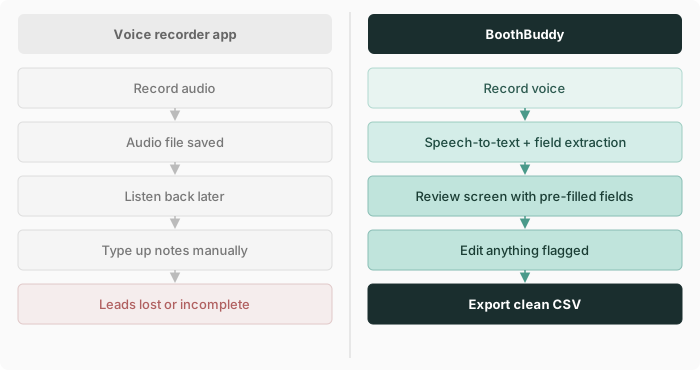
To go from audio file to structured lead, someone has to listen back, identify the name, pull the email out of how it was spoken (“j-a-y at acme dot com”), write out the company name correctly, and type the notes into whatever column the team uses. That’s a manual transcription job that scales poorly — fine for two leads, not fine for forty.
The throughput problem shows up at the booth too. When a note-entry workflow requires typing before each scan, it stalls at precisely the wrong moment. One reviewer at a plastics company described it: “The app required us to enter a typed note before we could scan the badge of the next potential lead at the trade show. This was somewhat time consuming especially when there are multiple people waiting to be scanned.” — Verified user, VP of Sales & Marketing, Plastics, Capterra Captello review, February 25, 2023.
When there’s a line forming, the notes get shorter. Or they get skipped entirely. By the time the team lands, those abbreviated notes don’t reconstruct much of anything.
What AI-structured voice capture does differently
The difference between a voice memo app and a purpose-built voice lead capture tool is what happens immediately after the recording stops.
In a voice lead capture app, the recording is not stored as a flat audio file. Speech-to-text converts it to text. Then a structured extraction step pulls the fields: name, email, company, title, and notes. The rep sees a pre-filled review screen — not a waveform, not a wall of raw transcription text. They scan the fields, correct anything that looks off, and save. The lead is structured and ready to export.
Audio note-taking has already picked up real adoption in lead capture contexts. One reviewer in event management noted it directly: “I also really enjoyed the ability to take notes using audio.” — Verified user, Event Lead, Small-Business, G2 Captello review, April 17, 2026.
What a dedicated voice capture workflow adds is the step that transforms the audio into something usable without a manual replay session. Capture happens at the booth. Structure follows after capture. The lead is ready to review before the next conversation starts.
Accuracy and the review step
The most common concern with voice capture for lead data is accuracy — especially for proper names, email addresses, and technical company names. The answer is not to avoid voice input. It’s to build in a fast review step that makes corrections easy. Every field should be editable before the lead saves. The review screen reinforces a habit experienced booth reps already have: reading back a lead record before closing it out. Doing that on a structured screen is faster than replaying the entire audio clip to find one detail.
The review step also handles the context that voice capture surfaces but a badge scan never would. A rep who mentions in their memo that a prospect is evaluating vendors this quarter, or that their budget opens in Q4, or that they came back twice to ask about implementation — all of that lands in the notes field. It’s reviewable before the lead closes, and it’s exportable with the rest.
What the workflow looks like
BoothBuddy is a mobile-first voice lead capture app built around this pattern. After a booth conversation, the rep taps record and speaks the lead in plain language: name, email, company, what they were interested in, any urgency signal. The app transcribes and extracts the fields automatically. The rep reviews, edits anything flagged, and saves. At the end of the show, the full list exports as a clean CSV.
There is no separate transcription job to run later. There is no folder of untitled audio files to sort through on the flight home. Each lead is structured at capture time — which is when the details are still fresh and corrections take seconds instead of guesswork.
If your booth team is already reaching for the voice recorder after conversations, the instinct is right. The workflow just needs one more step between the recording and the lead.
BoothBuddy is at boothbuddy.ai.